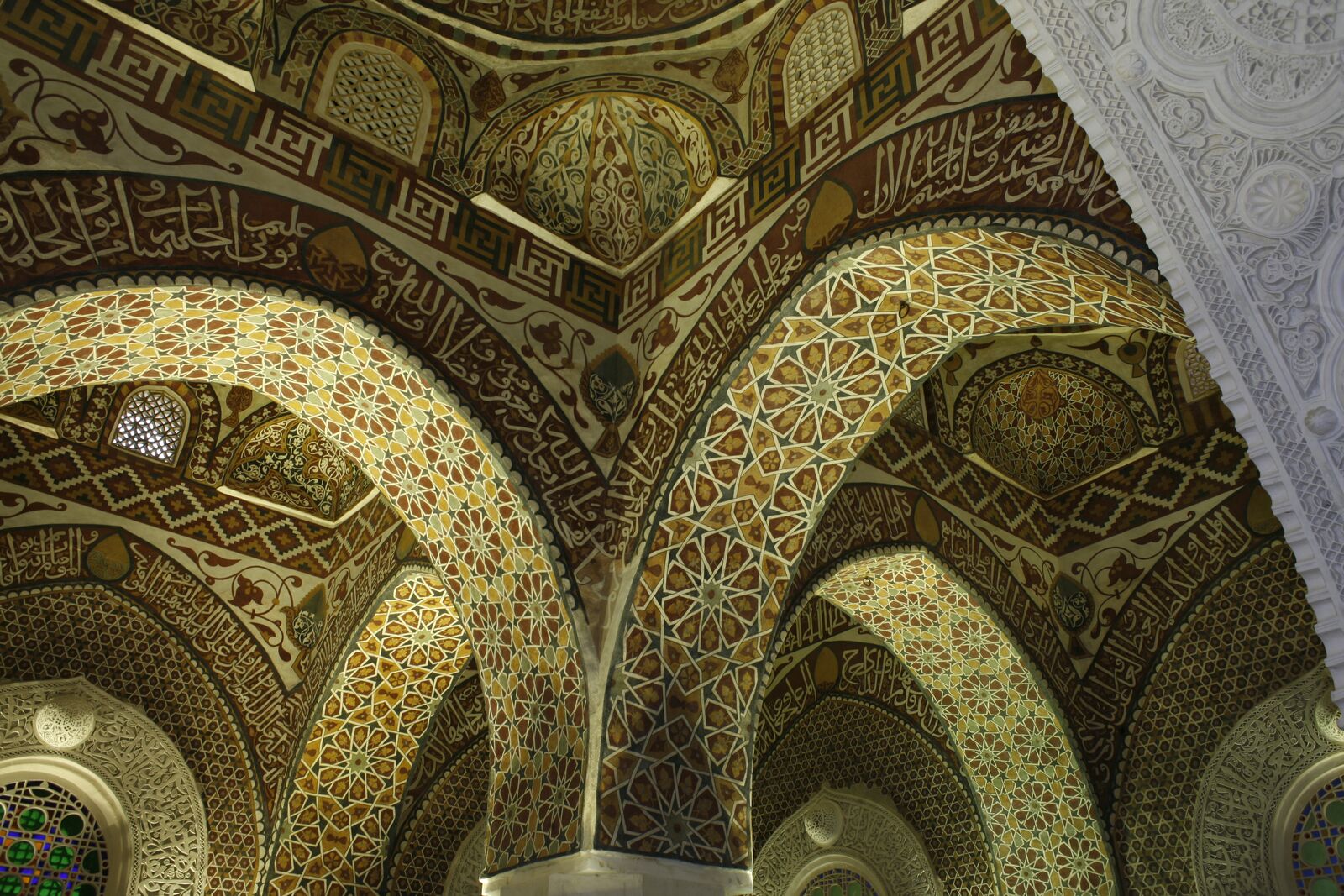
The al-Ashrafiya Mosque & Madrasa in Ta'izz is regarded as one of the architectural and artistic masterpieces in the Rasulit era (628-856 H/1229-1442),
which became the city of Ta'izz as its capital, the Madrasa had been built by the will of King al-Ashraf II, Ismail ibn al-Abbas, who took power after his father al- Abbas
for the period (778 -802 H/ 1376-1400). Since 1400, it became the burial place of the royal family. And it housed a Madrasa for orphans and a huge library, starting from the year 1500.
The building displays in general and motifs and patterns and colorful murals in particular for damage due to limitations of time and neglect for long periods and interventions
are not suitable for the purpose of maintenance and protection of the building, where he led those interventions and rainwater leaks to discredit large parts of the general appearance
of the building from the inside, though, the appearance General held many aesthetics as it is possible the restoration of those parts and re-aesthetic appearance to the public
by those previous interventions.
In 1978, rescue works had been implemented by inserting reinforced concrete beams in the walls under the domes' drums and lentils of the prayer hall.
This intervention caused a loss of more than 105 long meters of inscriptions and plant motifs. A reinforced concrete beams also been inserted on the top of the shrines courtyard and a column
as well outside the prayer hall.
1983-1996 AD, the accumulated layers of plaster above gypsum decoration on the walls of the prayer hall had been removed.
In 2003, an initial study and documentation had been prepared under the sponsorship of UNESCO, and was the basis to begin the restoration project.
In 2005, structural and architectural restoration works started within a comprehensive restoration project for the entire building and its annexes by the Social fund for Development (SFD),
which later included the fine conservation of the mural paintings in collaboration with the Instituto Veneto per i Beni Culturali (IVBC).
At the end of October of 2014 the comprehensive restoration works for the building and its annexes have been completed.
On January 22, 2015, the project was handed over to the local council of Ta’izz Governorate, and the building was officially opened to the public during an opening ceremony.
It should be noted that a local team of more than 66 conservation technicians had been trained on restoration project management and fine restoration of mural paintings, stucco, stones, and archaeological wood with the support of and supervision of Italian experts from the Veneto Institute for Cultural Heritage (IVBC), the total period of the project took 10 continuous years providing around (136,000) working day, person / day.